The last two steps in the accounting process are preparing a trial balance and then preparing the balance sheet and income statement. This information is provided in order to communicate the financial position of the entity to interested parties.
TRIAL BALANCE
A trial balance is a list and total of all the debit and credit accounts for an entity for a given period – usually a month. The format of the trial balance is a two-column schedule with all the debit balances listed in one column and all the credit balances listed in the other. The trial balance is prepared after all the transactions for the period have been journalized and posted to the General Ledger.
Key to preparing a trial balance is making sure that all the account balances are listed under the correct column. The appropriate columns are as follows:
Assets = Debit balance
Liabilities = Credit balance
Expenses = Debit Balance
Equity = Credit balance
Revenue = Credit balance
Should an account have a negative balance, it is represented as a negative number in the appropriate column. For example, if the company is $500 into the overdraft in the checking account the balance would be entered as -$500 or ($500) in the debit column. The $500 negative balance is NOT listed in the credit column.
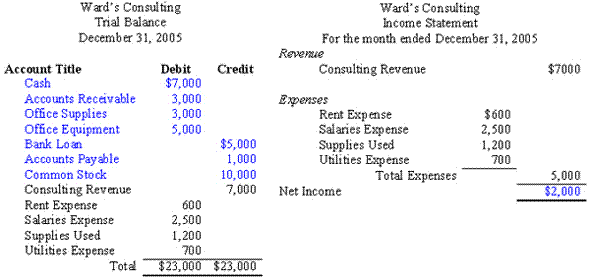
Example Trial Balance:

The trial balance ensures that the debits equal the credits. It is important to note that just because the trial balance balances, does not mean that the accounts are correct or that mistakes did not occur. There might have been transactions missed or items entered in the wrong account – for example increasing the wrong asset account when a purchase is made or the wrong expense account when a payment is made. Another potential error is that a transaction was entered twice. Nevertheless, once the trial balance is prepared and the debits and credits balance, the next step is to prepare the financial statements.
Income Statement
The income statement is prepared using the revenue and expense accounts from the trial balance. If an income statement is prepared before an entity’s year-end or before adjusting entries (discussed in future lessons) it is called an interim income statement. The income statement needs to be prepared before the balance sheet because the net income amount is needed in order to fill-out the equity section of the balance sheet. The net income relates to the increase (or in the case of a net loss, the decrease) in owner’s equity.

Now that the net income for the period has been calculated, the balance sheet can be prepared using the asset and liability accounts and by including the net income with the other equity accounts.

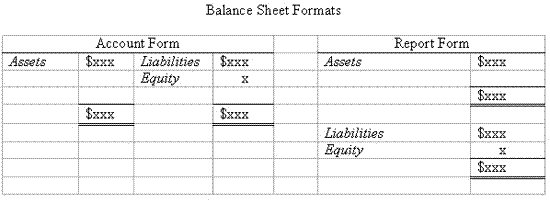
When preparing balance sheets there are two formats you can use. The format above is called the Report form and the Account form lists assets on the left side and liabilities and equity on the right side.
For a teaching lesson plan for this lesson see:
Trial Balance and Financial Statement Preparation Lesson Plan

It’s very helpful. And now I can prepare a trial balance.
Hi i would like some one to help me in accounting
Hi, in accounting, in which book do I put entries first?
You should keep record by ledger book first.
No first you enter Journal After this prepare separate Account That called Ledger.
Journal.
Where do I place account payables and account receivable in an income statement and balance sheet?
You put account payable balance at the credit side and put receivable at the debit side of the income statement.
In the balance sheet account receivable balance forms part of your current assets and account payable balance is part of your short term liabilities.
I hope this answers your question prince.
INCOME STATEMENT
RECEIVABLE IS PROFIT SO IT MUST SHOWN ON CREDIT SIDE AND PAYABLE IS EXPENSES AND IT MUST SHOWN ON DEBIT SIDE.
All payables are liabilities and all receivables are assets in balance sheet preparations.
johannah- General Journal Book
Prince nduke- Accounts Payable in Liability portion of Balance Sheet
and Accounts Receivable in Asset portion of Balance Sheet.
Help me understand the meaning of Trial balance, theory is different from practical.
Thank you for helping out, excellent info. “If you would convince a man that he does wrong, do right. Men will believe what they see.” by Henry David Thoreau.
Fantastic.
Thanks, it is very usefull for remembering the trail balance information.
ONE OF MY ONOTHER QUESTION IS HOW TO KNOW THE DEBIT AND CREDIT NOTES EASILY FOR RECORDING IN TALLY
Good solution.
Well I’m very interesting to let me my field of specialization as a professional accountant.